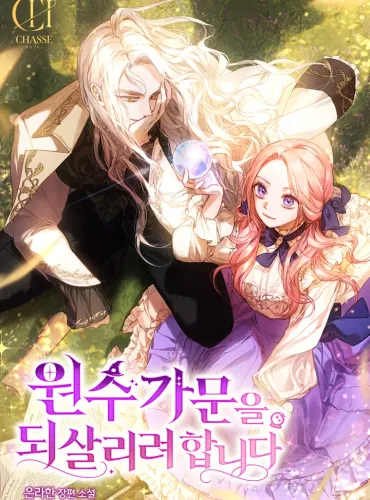
2.
Prantes introduced her to his employer as an old acquaintance.
Thanks to the employer’s consideration, Lunaria was able to speak with Prantes alone.
“Where are you staying?”
His voice sounded strangely earnest.
That couldn’t be.
He was the sort who had never clung to anyone in his life.
“……”
“Miss Lunaria.”
“I’m not called by that name anymore.”
“Then…?”
Lunaria did not answer.
Because she wanted him to remember her by that name—
as the Lunaria from those bright, lively days.
Instead, she asked:
“Are you married?”
She couldn’t help noticing the diamond on his left ring finger glittering from earlier.
“Ah.”
He covered the ring with his right hand, fiddling with it as if to hide it. His expression was uncomfortable.
She shouldn’t have asked.
“Yes.”
The conversation ended there.
Lunaria excused herself and left, walking straight out of the mansion.
Voices calling her back to the kitchen chased her staggering steps, but she didn’t care.
She would leave this town.
As always, she would simply disappear.
Whether she existed or not, the mansion—the world—would not change.
The wind roared, howling loudly.
Leaves along the roadside were swept away without resistance.
No different from her own situation.
Lunaria met Prantes twice more.
Every time they met, it was miserable.
He appeared at the most wretched moments.
It had been a long time since she’d thought of herself as miserable; she had long since given up on life.
Facing him—
it was unbearably painful.
“Lunaria!”
Hunched and walking with her shoulders drawn in, Lunaria turned her head as if hearing things.
Prantes was running after her.
He grabbed her thin wrist as she stopped and panted for breath.
She had never seen him like that.
“What….”
Without a word, Prantes took an old pocket watch from his coat and pressed it into her hand.
Lunaria flinched and tried to push it back to him.
Then Prantes closed her fingers around it more firmly and said,
“It is your aunt’s final gift to you.”
The old lady’s keepsake.
How could she refuse if he said it like that?
Lunaria turned her back on Prantes and walked away weakly.
When she finally looked back after a long while, Prantes was still standing there, blankly watching her.
As soon as Lunaria entered her small, bare room, she collapsed.
The pocket watch slipped from her hand and rolled across the floor.
Her breathing grew labored. It wasn’t like usual.
She could sense it—this was the final moment of her life.
Bang!
Perhaps the young wizard living upstairs had failed another experiment; the explosion sounded as if from a far, far place.
At least… I’m leaving quietly, without troubling anyone.
If she had collapsed while working at the employer’s mansion, there would have been a great commotion.
In her flickering consciousness, she saw the ring on Prantes’s delicate finger.
Was it the mark of a family contract carried on through generations, or a sign of the happiness he had finally found?
That she could wonder about such things even now—
the thought made a twitch of laughter pull at her lips.
If I had taken Prantes’s hand back then, what would have happened?
She wouldn’t have lived long anyway; perhaps she would have been perfect for the person he sought for a contractual marriage.
The dead do not speak, and secrets remain forever.
Though the proposal had come because of the old lady’s will, she wanted to accept it out of gratitude.
She wanted to prove—with him, in the capital—that she could be needed by someone, somewhere.
Lunaria’s eyes drifted shut, sinking into darkness.
After a short while, a violet aura welled up in the now silent room.
Click.
The hands of the pocket watch began to turn backward.
“Haa—”
Lunaria woke, her whole body soaked.
Cold sweat trickled down her back.
“…I’m alive.”
She had been certain she’d died.
But she hadn’t.
She slowly pressed a hand against her chest.
Her breathing was steady, and the crushing pain around her heart was gone.
Had the wizard boy upstairs saved her?
Maybe, in the midst of his research, he had taken a break, come down to visit, and found her.
What a good child.
It had been worth looking after his meals and daily needs like a little brother.
Lunaria wiped the sweat from her brow and the bridge of her nose, then lowered her forehead to her knees.
So she had to live this harsh life again.
Tormented by the anxiety of not knowing when or where she might die.
Then, the color of the blanket caught her eye—unfamiliar yet strangely familiar.
She jerked her head up. The view before her was familiar too.
Even in her dreams she could never recall it clearly, but now the structure came into focus, precise and whole.
A small, cozy room.
The room where Lunaria had spent all her maiden years before marriage.
“How can this be…?”
She hastily opened her palm to inspect it.
There were small calluses and dry little creases.
But it was certainly cleaner and softer than the hand she had last seen.
“I need to check.”
Lunaria threw back the blanket and sprang to her feet.
She went straight downstairs and knocked on her younger sister Lobelia’s door.
It was early morning, but she was too flustered to think of being considerate.
“Mmm, who is it?”
A clear voice, like rolling beads, answered the knock.
She’s here.
Lobelia was in that room.
Her heart pounded as if it would burst.
Fear or joy—she couldn’t tell. The confusion made her breath catch for a moment.
“Lia, it’s me. Your sister.”
Lunaria forced her voice steady.
“Yaaawn~ Did you come to wake me? No need. I want to sleep more.”
With that, Lobelia fell quiet again as if she had gone back to sleep.
Gently opening the door, Lunaria saw Lobelia fast asleep on the bed.
Sunlight streamed through the open casement, making her long, straight, beautiful silver hair gleam.
Beneath it, her closed, gentle eyes seemed free of any malice.
When those eyes opened, and her jewel-like amethyst pupils blinked, nine out of ten people fell for Lobelia.
Spotless, angelically pure.
This was the Lobelia whom young Lunaria had loved.
An indescribable surge of feeling swelled in her chest.
As much as she had cherished her sister, the betrayal had torn her apart.
While Lunaria lived in a pit of despair for the family’s sake, news came that Lobelia was living happily with the man who had once been Lunaria’s fiancé.
If she was happy, that should have been enough.
So she told herself…
But accepting that the hearts of her beloved family were not aligned with her own was like having her bones shaved away.
She gazed sadly at Lobelia’s peaceful, sleeping face, then could not bear it and turned her head.
Even by this time, Lobelia and her fiancé must already have been together.
Lunaria alone had not known.
Perhaps she had desperately looked away, pretending ignorance.
She walked to Lobelia’s dressing table.
After her father’s business failed, they had sold off furniture and trinkets, and the mirror had vanished from Lunaria’s room—but one remained in Lobelia’s and in her stepmother’s.
With shaking hands, she lifted the small mirror from the table and brought it close to her face.
Crash!
The mirror slipped and shattered on the floor with a loud clatter.
“Sis, please keep it down.”
Lobelia whined in a sharp voice.
“Sorry.”
Lunaria apologized out of habit, then carefully picked up the mirror again to check her face.
In the cracked glass, a youthful face reflected back.
Her wavy, golden hair shone with luster.
Her leaf-green eyes brimmed with curiosity, and the corners of her lips curled as if always smiling.
Yes… this was my face.
Was this a dream?
If it was, should she wish to wake—or wish to live in it?
In a life that would become unhappy no matter what she did.
“Luna!”
Footsteps thumped through the open door.
“I’m here.”
Lunaria opened the door a little and replied.
Her stepmother, Imelda, who had been climbing the stairs to find her, turned, came over, and seized Lunaria’s wrist roughly.
Seeing Imelda made loathing boil up in her chest.
“What are you doing in there? Come out at once.
Lia is sleeping and you’ve barged in making noise again!”
How vividly unreasonable her scolding was.
So it wasn’t a dream after all.
Lunaria pried Imelda’s hand off with a firm grip.
“What is it?”
“Not a single thing for breakfast has been prepared. What is the meaning of this?
Are you unwell? You’re not the sort of girl who would let our family starve.”
Did Imelda’s “our family” include Lunaria?
After the servants were dismissed for lack of wages, Lunaria had taken over all those duties alone.
Why did I do that, really…
All that devotion, repaid with her sister’s betrayal and an awful engagement to an aging count—
not even a simple “thank you.”
She had been a fool.
“No, I’m fine.”
“Then why?”
Imelda’s voice sharpened irritably.
“Mother.”
A cold voice slipped from Lunaria’s lips.
“In these hard times, you’ve worked yourself ragged looking after Father, me, and Lobelia.”
“Don’t change the subject. If you did wrong, you say ‘I’m sorry,’ that’s all.
You always have too much to say.
How will a husband love you like that, always talking back about everything?
Go set the table, quickly. You’ll anger your father.
Who looks after you except me?”
It had always been like this.
Imelda always blamed Lunaria.
Why are you like that? It’s embarrassing—don’t behave that way outside.
I’m saying this for your own good, so take it to heart.
You won’t? Then too bad. Because of you, the family will starve to death.
Then she would feel as if she’d committed a great sin.
Imelda’s words poked at her like awls.
She had been deceived into believing that the guilt she felt was natural, and that she was choosing—of her own will—to devote herself to the family.
But living apart from them, she realized something on her own.
All those words had been brainwashing—meant to use Lunaria as Imelda pleased.
At last, Lunaria said the words she should have spoken long ago.
“I’m going to become independent.”